
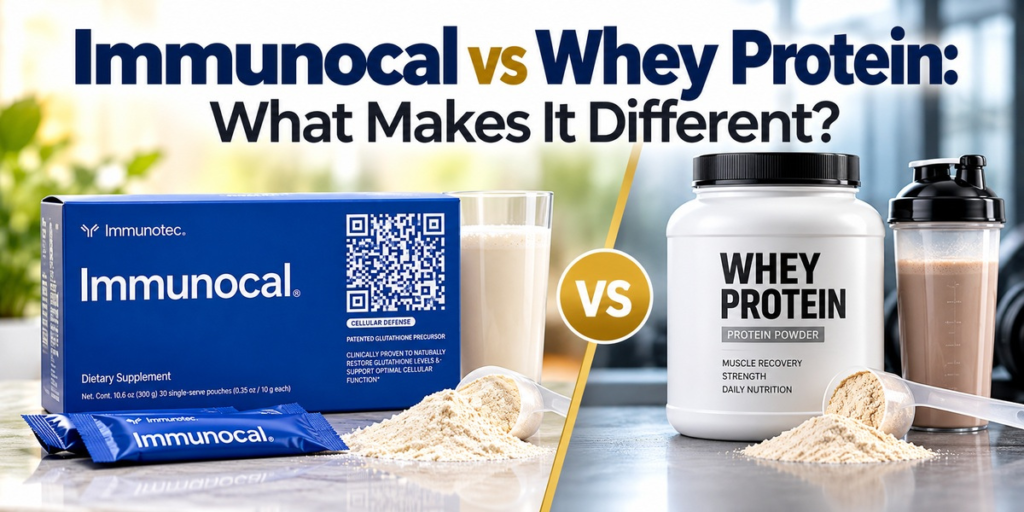
When shopping for protein supplements, most people look at how much protein they get per serving, the ingredients, and the price. That’s a sensible place to start. But not every protein supplement is made with the same purpose in mind.
Immunocal is a whey protein supplement developed by Immunotec. Unlike many traditional protein powders that focus on muscle growth and recovery, Immunocal is formulated around a different nutritional goal: supplying cysteine-containing whey proteins that support the body’s natural production of glutathione.
That raises an important question. Is Immunocal really different from regular whey protein, and is that difference worth paying for?
Quick Answer: What Makes Immunocal Different?
Immunocal is a specially processed, undenatured whey protein isolate designed to preserve cysteine-containing proteins. Cysteine is one of the amino acids your body uses to make glutathione, an antioxidant involved in normal cellular protection.
Regular whey protein also contains cysteine and provides high-quality nutrition. The main difference is Immunocal’s specific processing method, formulation, and emphasis on glutathione support rather than simply delivering a large amount of protein per serving.
Neither product is automatically better for everyone. The right choice depends on your nutritional goals, budget, and what you expect from a supplement.
Disclosure: ImmuneGluta.com has a commercial relationship with Immunotec. We may earn compensation from qualifying purchases. Our goal is to help readers understand the products and make informed decisions.
What Is Immunocal?
Immunocal is a whey protein isolate made from milk. Like other complete whey proteins, it provides all nine essential amino acids that the body cannot make on its own.
What makes Immunocal unusual is the way Immunotec processes the whey protein and the purpose behind that formulation.
Traditional whey protein powders are often sold to athletes, fitness enthusiasts, and people who need more protein in their diets. Immunocal is marketed primarily for its cysteine-containing proteins and their connection to glutathione production.
This does not mean Immunocal is an entirely different type of protein. It still comes from whey, just like many popular protein powders.
The distinction is in how the product is manufactured and what the manufacturer is trying to preserve.
Immunocal vs Regular Whey Protein: Key Differences
Immunocal and traditional whey protein have several things in common, but there are also important differences to consider.
| Feature | Immunocal | Regular Whey Protein |
|---|---|---|
| Protein source | Milk-derived whey protein isolate | Whey concentrate, isolate, or hydrolysate |
| Complete protein | Yes | Yes |
| Main focus | Cysteine-containing proteins and glutathione support | Daily protein intake, muscle maintenance, and recovery |
| Processing | Designed to preserve undenatured whey proteins | Processing varies by product |
| Cysteine | Contains cysteine-rich whey proteins | Also contains cysteine |
| Formulation | Uses Immunotec’s proprietary processing approach | Depends on the manufacturer |
| Product research | Some studies have examined Immunocal | Extensive research exists on whey protein generally |
| Best fit | People specifically interested in Immunocal’s formulation | People mainly looking to increase dietary protein |
The most important difference is not that Immunocal contains an amino acid missing from ordinary whey protein. Both products provide cysteine.
Instead, Immunotec has developed a particular whey protein formulation intended to preserve cysteine-containing protein structures.
Whether that difference justifies the cost depends on what you’re looking for and how much value you place on the specialized formulation.
Why Does Undenatured Whey Protein Matter?
One of Immunocal’s most frequently discussed features is that it contains undenatured whey proteins.
To understand what that means, it helps to know a little about protein processing.
Proteins have natural three-dimensional structures. Heat, acidity, and other processing conditions can change those structures. This change is known as denaturation.
Immunocal is manufactured using a process intended to preserve certain whey proteins in their original, undenatured form.
Immunotec considers this an important part of the product’s design because some whey proteins contain cysteine linked within their natural structures.
However, denaturation does not automatically make a protein unhealthy or nutritionally useless.
Your digestive system breaks down proteins into smaller components and amino acids. Many ordinary whey protein powders remain excellent sources of complete protein even when some proteins have been denatured during processing.
The real question is whether preserving particular whey protein structures provides meaningful advantages for the purpose you have in mind.
That’s why Immunocal’s formulation deserves a closer look rather than simply assuming all whey protein powders are identical.
What Is Bonded Cysteine in Immunocal?
You may see the term Bonded Cysteine when reading about Immunocal.
Immunotec uses this term to describe an important feature of its whey protein formulation.
Cysteine is an amino acid that helps the body produce glutathione. In proteins, cysteine can be present in chemical arrangements involving bonds with other amino acid components, including disulfide bonds.
Immunotec emphasizes preserving cysteine-containing structures during manufacturing as part of its approach to delivering glutathione precursors.
In simple terms, the company isn’t just focused on the total amount of protein in the package. Its formulation is intended to preserve specific components of whey that are relevant to its nutritional purpose.
That does not establish that Immunocal delivers more usable cysteine than every other whey supplement, or that the preserved structures produce superior health outcomes in all consumers.
It does explain why Immunocal is positioned differently from an ordinary protein shake.
How Is Immunocal Connected to Glutathione?
Glutathione is an antioxidant that the body makes naturally. It is present in cells throughout the body and helps protect them from oxidative stress.
Oxidative stress occurs when the balance between reactive molecules and the body’s protective systems becomes disrupted.
Glutathione also participates in normal cellular processes, including certain functions involved in maintaining healthy cells.
Your body makes glutathione from three amino acids: glutamate, cysteine, and glycine.
Cysteine is particularly important because its availability can sometimes limit glutathione production.
This is the nutritional connection behind Immunocal.
By supplying cysteine-containing whey proteins, Immunocal is designed to provide building blocks the body can use in its normal glutathione-producing processes.
Does Immunocal Actually Contain Glutathione?
Immunocal is best understood as a source of glutathione precursors rather than a supplement intended primarily to deliver ready-made glutathione.
A precursor is a substance the body can use to produce something else.
In this case, the focus is on supplying amino acids involved in glutathione production.
This is different from purchasing a supplement containing glutathione itself, including products marketed as liposomal glutathione.
Another supplement often discussed in this category is N-acetylcysteine, commonly called NAC. It provides a form of cysteine through a different approach.
These products should not be treated as interchangeable. Their ingredients, research, intended uses, and safety considerations differ.
For someone comparing these options, the most useful question is not simply which product sounds strongest. It’s which approach is appropriate for their individual needs.
What Does Scientific Research Tell Us?
There is a well-established biological relationship between cysteine and glutathione production. Cysteine is one of the amino acids required to make glutathione, and whey protein is a dietary source of cysteine.
That gives Immunocal’s formulation a reasonable nutritional basis.
However, understanding how the body makes glutathione is not the same as proving that one commercial protein supplement works better than all others.
Immunocal has been investigated in clinical research, but the available evidence should be interpreted carefully. Studies involving particular medical populations cannot automatically be used to predict results in healthy adults.
The most important distinction is between what is known about normal human nutrition and what has been demonstrated for a specific product.
What we can say with confidence is that Immunocal provides whey protein containing cysteine, and cysteine is involved in the body’s production of glutathione.
What should not be assumed is that everyone who takes Immunocal will experience a measurable increase in glutathione, improved immunity, or a particular health benefit.
Immunocal is a nutritional supplement, not a treatment or cure for disease.
Is Immunocal Better Than Regular Whey Protein?
That depends on what you want your protein supplement to accomplish.
For someone who wants to increase daily protein intake, traditional whey protein may be the more practical option. Many products offer substantial amounts of complete protein per serving, often at a lower cost per gram of protein.
Regular whey protein is commonly used to support muscle maintenance, exercise recovery, and daily nutrition.
Immunocal has a different emphasis. Its formulation is centered on preserving undenatured whey proteins and supplying cysteine-containing components.
If you’re specifically interested in that approach, Immunocal may be worth considering.
But if your main goal is to add more protein to a smoothie after a workout, there’s no reason to assume you need Immunocal instead of a conventional whey protein powder.
Can Regular Whey Protein Also Support Glutathione Production?
Yes. Regular whey protein contains cysteine, along with other amino acids used in normal body processes.
Immunocal does not have exclusive access to the ingredients the body uses to make glutathione.
The difference lies in its particular formulation and processing approach.
This is why claims that Immunocal is automatically superior to every other whey protein product should be treated cautiously.
How Much Protein Is in Immunocal?
Immunocal is a protein supplement, but it’s important to compare the actual serving information rather than assuming it is equivalent to a large sports protein shake.
Conventional whey protein products often provide around 20 to 30 grams of protein per serving, although amounts vary.
Immunocal’s serving size and protein content should be checked against the current official product label.
That matters because a comparison based only on the number of packets or scoops in a container can be misleading.
For someone trying to reach a specific daily protein target, the number of grams of protein per serving is an important consideration.
For someone interested in Immunocal’s specialized formulation, the protein amount is still worth knowing, but it may not be the only factor influencing the purchase.
Why Does Immunocal Cost More Than Some Whey Protein Powders?
One of the biggest questions buyers have is whether Immunocal is worth its price.
Regular whey protein is sold by many manufacturers, with prices varying according to protein concentration, ingredients, brand, and quality controls.
Immunocal is marketed as a specialized product with a proprietary processing approach. That positioning can make it more expensive than conventional protein powders.
However, a higher price does not automatically mean better results.
When comparing products, consider the cost per serving, the amount of protein provided, the ingredient list, and the purpose for which each supplement is marketed.
For example, someone whose only goal is to increase daily protein intake may find that a standard whey protein powder offers better value.
Someone specifically interested in Immunocal’s formulation may evaluate the price differently.
Before purchasing, check current pricing and package sizes, since promotional offers, subscriptions, and other purchasing options can affect the total cost.
Who Might Consider Immunocal?
Immunocal may appeal to people who are interested in learning more about undenatured whey protein and the relationship between cysteine and glutathione.
It may also interest consumers who prefer a supplement developed around a particular nutritional formulation rather than a conventional sports protein powder.
Still, it’s important to have realistic expectations.
Immunocal should not replace a balanced diet, adequate protein intake, prescribed medication, or medical care.
People with a milk protein allergy should avoid milk-derived whey protein products. Anyone with kidney disease, a prescribed protein restriction, or other relevant medical concerns should speak with a qualified healthcare professional before using a protein supplement.
If you’re comparing Immunocal with other products, start by identifying your actual nutritional goal. That will help you make a more useful comparison than relying on advertising claims alone.
Frequently Asked Questions About Immunocal
Is Immunocal the same as whey protein?
Immunocal is a type of whey protein isolate, but it uses a specialized processing approach intended to preserve undenatured whey proteins. Traditional whey supplements may use different processing methods and are commonly marketed for daily protein intake and exercise-related nutrition.
Does regular whey protein contain cysteine?
Yes. Regular whey protein naturally contains cysteine. Immunocal’s distinguishing feature is its specific formulation and emphasis on preserving cysteine-containing whey protein structures, not the exclusive presence of cysteine.
Is Immunocal better for building muscle?
There is not enough evidence to conclude that Immunocal is generally better for muscle growth than conventional whey protein. For muscle-building goals, total daily protein intake, exercise, and overall nutrition remain important considerations.
Does Immunocal increase glutathione?
Immunocal supplies cysteine-containing proteins involved in the body’s natural glutathione production. However, the amount of any increase may vary, and the product should not be assumed to produce a particular result for every individual.
Is Immunocal worth the money?
It depends on your goals. If you’re looking for an affordable way to increase daily protein intake, conventional whey may be a better fit. If you’re specifically interested in Immunocal’s undenatured whey protein formulation, you may find its specialized approach worth considering.
Final Thoughts: Is Immunocal Right for You?
Immunocal is different from traditional protein supplements, but the difference is more specific than many people realize.
Both Immunocal and regular whey protein provide complete protein and amino acids, including cysteine. Regular whey is often purchased to help meet daily protein needs, while Immunocal is formulated around preserving undenatured whey proteins associated with the body’s natural glutathione-producing processes.
That makes Immunocal a distinct product, not automatically a superior choice for every person.
If you’re mainly looking for protein to support exercise or daily nutrition, traditional whey protein may meet your needs at a lower cost.
But if you’re interested in Immunocal’s particular formulation and want to understand what it offers, the next step is to review the product details, current ingredients, serving information, and available purchasing options.
Interested in trying Immunocal?
Visit our Immunocal product page to review the current product information and explore available purchasing options.
View Immunocal Product Details and Buying Options
Disclosure: ImmuneGluta.com may receive compensation when you purchase through our product links. We are an independent Immunotec-affiliated website, not a substitute for professional medical advice.
About the Author
This article was prepared for ImmuneGluta.com, an independent website providing educational information about Immunotec products, whey protein, and glutathione-related nutrition.
The website has a commercial relationship with Immunotec. Product information is presented alongside general nutritional explanations to help readers make informed purchasing decisions.
References and Further Reading
- Immunotec: Current official Immunocal product information and labeling. Used to confirm the manufacturer’s description of its formulation and intended use.
- National Institutes of Health, Office of Dietary Supplements: General educational information on dietary supplements and evaluating supplement claims. https://ods.od.nih.gov/
- National Library of Medicine, PubMed: Research database for reviewing published studies on whey protein, cysteine, and glutathione. https://pubmed.ncbi.nlm.nih.gov/
Editorial note: Specific clinical-study findings have been excluded from this draft rather than presenting unverified results or statistics.
